Showing posts with label Reptiles - Lizards. Show all posts

Monday, May 26, 2008

King's Skink - Egernia kingii

A big, fast and sociable reptile

I first encountered this skink when walking on a rocky outcrop near Albany, Western Australia. I never saw one, but heard them scuttle away into the bush upon my approach. At that stage I had not noticed any around the Esperance region, but one day a large female payed me a visit; liked what she saw and stayed. She was attracted to my concrete veranda and a metal skid I had placed on the ground with a northerly aspect, so plenty of sun, but not the hot afternoon sun. The skid was 6' long x 15" wide and 2" in height and had openings at both ends, as far as Mrs King was concerned it was perfect and she made it her home. She arrived in late autumn and shortly after produced two young who would rest on her back as she sunbaked as winter approached. She over-wintered with them in her new home.

King's Skink - Egernia kingii

My apologises for the poor photography, but despite the three years she and numerous off-spring have lived here, they remain ever watchful and will disappear back under their skid if I stop at a window to watch them. So photos have all been taken from a distance and through a closed window, even then it was very difficult as they have excellent eyesight and are extremely shy.

The visiting male King's Skink and the slightly larger female

The large female is well over half a metre long and possibly as much as 600 mm in length. These lizards are live breeders and she has produced twins, twice a year, with the young usually remaining with her for around 12 months and sometimes even longer (she now has only a single annual litter of 4 or 5 young). She will come and go during the warmer weather, but is never away longer than 2-3 weeks. The male will visit occasionally, but does not remain long and is usually gone after a few days. However several generations living together are not unusual, although those nearing sexual maturity leave to presumably start their own families, nevertheless some do return for short periods and are accepted back into the family. Probably limited food and suitable accommodation determine the number that can remain for any length of time.

King's Skinks being sociable

In a previous post of mine concerning another large skink, the Western Blue-tongued Lizard (click item 34 in right-hand column), I produced a photograph of an aboriginal lizard trap. On other granite outcrops in the region I have come across a number of these traps and believe they were primarily used to trap the King's Lizard, which is not only shy, but very fast and would have been difficult to catch by other means.

The speckled coloration is similar for the young and adults

King's Skink - Egernia kingii

A young King's Skink who slipped into the house and took shelter in a box

Despite the large size of these lizards, I have only seen them near their nest site and although they leave highly distinctive tracks when crossing sandy areas, I have not seen these elsewhere in the district, so presume these lizards are not common.

Typical tracks of the King's Skink, note the neat straight furrow

Monday, February 04, 2008

Western Bearded Dragon, Pogona minor minor


A lizard from the old world family Agamidae.

Agamidae are part of the infraorder Iguania, which is the very first branch of the lizard evolutionary tree, making them amongst the most primitive of lizards and are thought to represent the eastern Gondwana relative of the Iguania. Although amidst debate, these ancestral lizards are reasoned to have arisen in the South American continent and spread via Antarctica to the Indian subcontinent and Australia, both of which contain the largest number of endemic species.

The Australian agamid clades are concentrated in the more arid regions of Western, Northern and Central Australia with fewer species in the wetter and more heavily forested areas of Eastern Australia. This probably reflects the breaking up of Gondwana and the retreat of the forests as Australia dried whilst drifting north. It is during this period that agamids in Australia began to diversify and become more common in the fossil record. Pogona was one of these lizards!

Western Bearded Dragon, Pogona minor minor

The Western Bearded Dragon, Pogona minor minor is often simply referred to as Pogona minor (the second minor referring to its subspecies status) as it occupies most of WA, except for the northern region, the Nullarbor and the SW corner. Another subspecies, Pogona minor minima or the Abrolhos Bearded Dragon, only occupies the Houtman Abrolhos Islands. A third subspecies Pogona minor mitchelli is found in the far northern near coastal portion of WA.

Pogona minor is not a particularly large lizard, growing to a little over 15" (38 cm) in length including the tail, but going on its distribution it is obviously a very successful species and besides occupying a very large portion of WA, also extends into the western half of SA and the lower SW of the Northern Territory. The Eastern Bearded Dragon (a similar looking lizard from eastern Australia) abuts in the coastal Adelaide region. This eastern species, Pogona barbata, is a little larger than its western counterpart and differs by having several rows of large spines along its flanks, whereas the western bearded dragon has only one.

A mating pair of Western Bearded Dragons

All dragon lizards are egg layers and are often seen digging a nesting chamber where up to 12 eggs are deposited, after which the connecting tunnel is filled in. This activity can take several days and is often thought that she has abandoned the nest, but more often she is busy inside, evidenced by the opening being in-filled a day or two later. In good seasons the western bearded dragon can produce two or more clutches, making this nesting operation quite common and often observed.


Pogona minor digging the nesting chamber, and not impressed by my interest.
Hidden at last!


These lizards have a reputation of being lovers of the sun, preferring the more open arid regions and often seen sunbaking. But this is not quite correct as they require a narrow temperature range and when this is exceeded (as is often the case during summer), they seek shelter and are considerably less active. Dragon lizards are commonly seen perched on posts and other elevated positions during spring and early summer, this not only provides them with sunbaking opportunities, but a means to survey and maintain their breeding territory. They are also often seen sunbaking in autumn, but are seldom encountered during summer and then usually only early in the morning.


A disturbed sunbaking western bearded dragon reviewing the potential threat.


Pogona eat a variety of foods including vegetable matter like flowers and even seed, although insects and other invertebrates would make up the bulk of their diet, however the odd small, slow moving mammal would not be ignored.

Typical dragon surveying its territory for rivals, mates, predators and prey.

Western Bearded Dragon, Pogona minor minor


Dragon lizards are well known for their visual method of communication where head bobbing, leg and body lifting are commonly practised. Apparently each dragon species has its own procedures, but all aim to discourage other males or to attract a mate, but the most dramatic display is used in defence to deter a potential predator. Here the lizard will flatten its body which is turned towards the threat to make it appear bigger, the frill is fully extended with all spikes projecting away from the body and the mouth wide open to show a colorful interior. All bluff of course, but still very effective.

A well camouflaged western bearded dragon keeping a lookout from a dead tree trunk.


Unlike most skinks and geckos, dragon lizards do not shed their tails to escape from predators, but can run very fast with a sudden turn of speed, some even running bipedally like a crazed clown, plus they are very good at climbing, so probably suffer less predation. However unlike the blue-tongue lizards, they are nowhere near as common in the big cities unless there are large open spaces so they can keep an eye on their territory and use their speed to avoid predators.


All kids are cute, as it this young Pogona minor frolicking amongst the Trigger Plant flowers.centre


Australia is a land of reptiles, particularly in the more arid areas with unreliable rainfall and consequential irregular food supply; it nevertheless suits perfectly the biological make up of reptiles. Their more energy saving lifestyles, along with their lower requirements of food and water allow them to take advantage of the good times, whilst also surviving well the bad. So when you next look at a reptile, don't think of them as being primitive, but supremely well adapted. They were here long before we came onto the scene and will probably be around long after we depart. Many think reptiles are dumb, but this is certainly not the case, they have very good memories and some are very social, but the most striking thing about them is how accommodating they are if they live near you. Providing you don't threaten or interfere, most will treat you with great respect and will be no trouble at all. We should make room for more reptiles in our lives, for not only are they interesting and entertaining, but generally will eat the things we don't like. So get eco-friendly, help reptiles to help you!


Sunday, January 13, 2008

Western Blue-tongued Lizard, Tiliqua occipitalis

Australia's largest skinks, subfamily Tiliquinae or the Egernia Group


There are two genera (Egernia and Tiliqua) represented in Australia from the subfamily Tiliquinae, which include the largest skink species. However DNA research has indicated a more complex relationship resulting in new groupings of related skinks, of which Egernia and Tiliqua have been placed with the genus Cyclodomorphus to form the Egernia Group, all of which are represented in Australia. These skinks can grow to over half a metre in length (including the tail), some are highly sociable and all bear live young.

The ancestors of these skinks are thought to have originated in Africa sometime after the demise of the dinosaurs and gradually migrated to various parts of the world, eventually arriving in Australia during the Pliocene (1.6 to 5.3 million years ago), via multiple colonisations from Southeast Asia. Since then they have evolved to around 40 odd indigenous species, the most from Egernia (currently 28 species), Tiliqua 6 species and Cyclodomorphus 9 species.

Skinks in the genus Tiliqua are known as 'Blue-tongue' lizards as all have a large flat blue tongue that is not only used to discourage predators, but also to scent prey.

I have already written about one Tiliqua species, T. rugosa (see item 10. Stumpy-tail Lizard ), which is very common in the Esperance region. Tiliqua occipitalis, the Western Blue-tongued Lizard is the only other Esperance (Western Australia) member of this genus, and is far less common, particularly in the sandy heath zones (the most common habitat in the Esperance region). This blue-tongue is more common around granite outcrops, probably reflecting its preferred habitat providing shelter under rocks from feral cats and foxes, both known to take a heavy toll on local wildlife. However if they manage to survive, they can live 20 to 30 years.


A female Western Blue-tongued Lizard, Tiliqua occipitalis


In the southeastern States (SA, Vic, NSW & southern Qld), there is a similar Blue-tongue Lizard naturally called the Eastern Blue-tongue or Common Blue-tongue Lizard. This skink grows to a similar size as its western cousin, but differs in several respects. The first noticeable feature is the general coloration; the western has a yellowish/brown overall look, whereas the eastern is more silvery grey. The bands on the body and tail also differ, with 4-6 DARK bands on the body (nape to hips) for the western, as against 6-9 PALE body bands for the eastern. There are 3-4 encircling dark bands on the western blue-tongue's tail, whereas the eastern has 7-10 pale bands.

So the basic coloration and number of bands are the easiest way of telling these two species apart, although there can be considerable variation with the markings. Other differences involve the number of live young each species produce, with the eastern being the more prolific by producing up to 25 young, although around half that number would be the norm. The Western Blue-tongue by contrast only produce from 5-10 young, but they are larger at birth. Neither species devote much time to their offspring and the young usually disperse within a few days to lead independent lives.


Western Blue-tongued Lizard, note the overall brownish hue


There are differences between male and female blue-tongue lizards; most obvious is the size of the head! The male's head is much broader than the female, who usually also has a longer body and shorter limbs. The males are usually more aggressive, although both can put up a good display to deter predators. Besides a deep guttural hiss and a gaping pink mouth to reveal a flickering broad blue tongue, they (particularly the western species) can flatten themselves by spreading their ribs, which they then turn side on towards the predator to make them appear much larger.


A male Western Blue-tongued Lizard


It is commonly thought that all skinks shed their tail to distract a predator. However this is not the case with all the skinks from this group, T. rugosa, the Stumpy- tail Lizard, plus several Egernia species lack fracture planes in their vertebrae so are unable to do so. Other species in this group gradually lose their ability to discard their tails as they mature, but could do so when young.

The blue-tongue lizards have a very catholic diet eating soft plant matter, flowers and fruit, crunchy beetles and other insects, spiders, small lizards, even silly young birds who venture too close, in fact they will eat almost anything that is slow enough and will fit into its large mouth, this also includes garden snails which they are able to crush with their strong jaws, so placing fingers near their mouth is not a good idea. Their limitation regarding diet is governed by their small legs and large body, which apart from a short lunge, mean they are normally quite slow and usually only able to catch slower prey.

As a word of caution, if you are fortunate to have these skinks living in your garden, please do not use snail pellets as they will eat the dying slugs and snails and become poisoned themselves. Best to leave it to your blue-tongue lizards to control your slug/snail problem.


Always ready for the next meal

Western Blue-tongued Lizard, Tiliqua occipitalis

Besides cats, dogs and foxes; snakes and birds will take young lizards, plus I strongly suspect they were also on the aborigine's menu. On some of the less frequented rocky outcrops around Esperance, lizard traps can still be found, these would have been used to catch another very large skink (as big or bigger than the western blue-tongue), Egernia kingii or the King's Skink that looks a little like a goanna. It has longer legs than Blue-tongue Skinks and can run very fast (been clocked at over 3 metres a second), so difficult to catch. However a large granite slab could be dropped on them simply by removing the supporting rock (see photo below). Therefore not only could these traps be used to catch these fast skinks, but the elevated slab would also provide good accommodation for the slow moving blue-tongues, who could easily be captured by hand. So travelling bands of aborigines could camp near a rocky outcrop and likely catch an easy evening meal, resetting the trap upon leaving to entice another large lizard for capture when they return on another occasion.


An aboriginal lizard trap, about a metre long x half a metre wide. Some are larger and require two rocks to support the granite slab.


The Western Blue-tongue has an extensive distribution, from the WA mid west coast, the southern goldfields, over the boarder to occupy much of SA, even extending into the Northern Territory. This species is also found in western NSW, Qld and Victoria, although here they are becoming increasingly rare. It is primarily a lizard of arid regions and is not normally found in cool forests. Probably it is this more open, warmer and drier habitat preference that excludes it from the eastern species range, where forested areas are more extensive but are not a problem for the eastern blue-tongue providing the forested area is not too wet and sunlight can reach the forest floor.


This Western Blue-tongue is not being rude, just smelling the environment with its tongue


Blue-tongue lizards are quite common in most capital cities these days, possibly as there are fewer predators who wish to eat them, rather, most domestic animals are more curious and easily discouraged by their aggressive display. To attract them to your garden, place large logs, rocks and have plenty of ground cover in which they can shelter. Do not use snail pellets and watch out when mowing. Then besides a harmless, attractive, interesting and interactive garden resident, you also get a free creepy crawly and expert snail catcher to boot. Sounds like a good deal to me!

Saturday, November 18, 2006

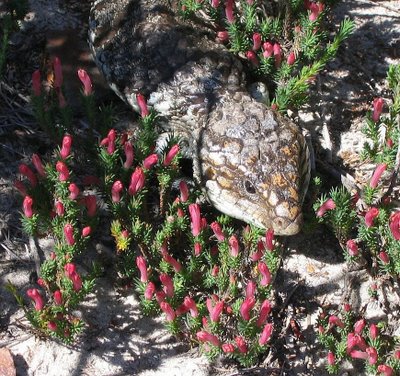
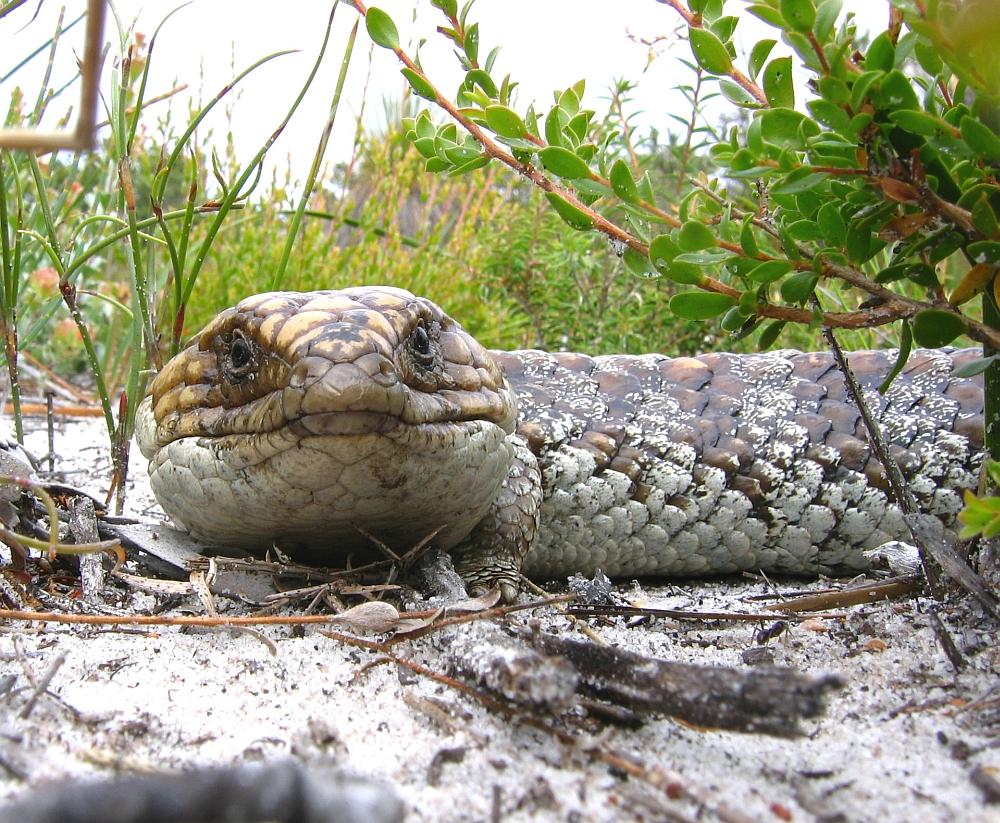
The highly successful Stumpy-tail Lizard, Tiliqua rugosa

Also known as the Shingleback, Bobtail, Sleepy Lizard, Pinecone Lizard and the Boggi.

They occur in the drier regions of five States and do remarkably well in built-up areas, living under houses, in pipes, under vegetation, rocks or logs. They are omnivores and happily eat snails, slugs and caterpillars, they also consume a large selection (more than most reptiles) of vegetation, flowers and fruits. Although you might not want a Stumpy-tail in your strawberry patch, they are otherwise excellent for keeping many plant-eating pests under control.
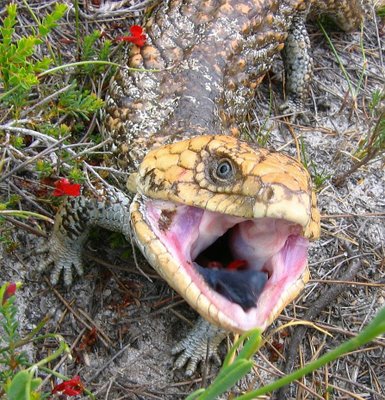
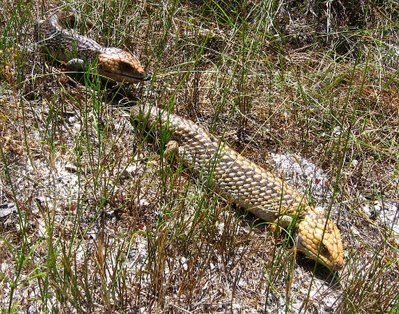
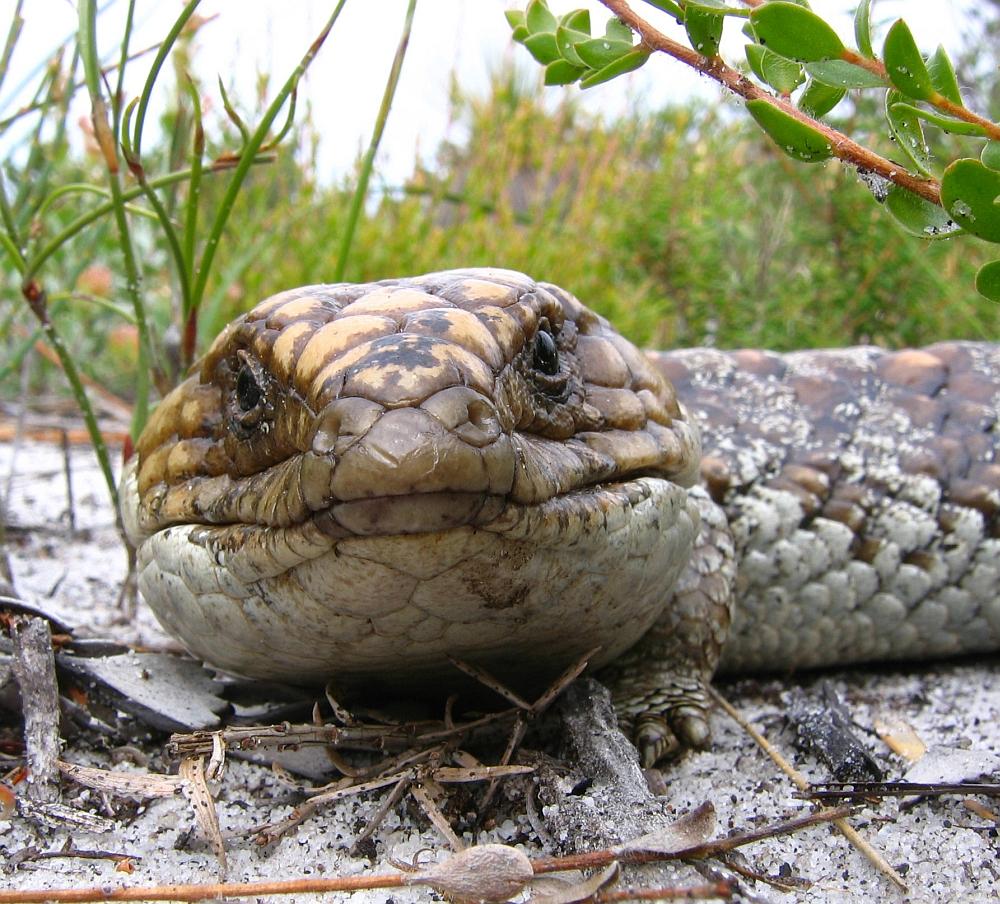
These lizards are a dentist's delight. If you say open wide, the head almost separates in two, showing strong muscles and a broad fleshy purple/blue tongue. The males although slightly smaller than the females (can grow to over 40 cm in length) have the larger head and during the breeding season can be very aggressive to other males.


These lizards are usually solitary, but do not avoid others and often meet up during the year. However, they sort themselves into couples at the approach of the mating season (September to November). Initially they just go about together, but closer to the time of mating, the male follows the female around for a couple of weeks and lookout any unattached male in their vicinity, as they are chased off very smartly, however other roving couples are not met with the same aggression. This may be because they only have one partner per season, although the same pair may get together for several years. One couple has been recorded in a ten year relationship, the longest known for any reptile. From two to six young are born live, five months after mating and are independent from birth, although strangely, close family members can apparently recognise each other even after long separation.


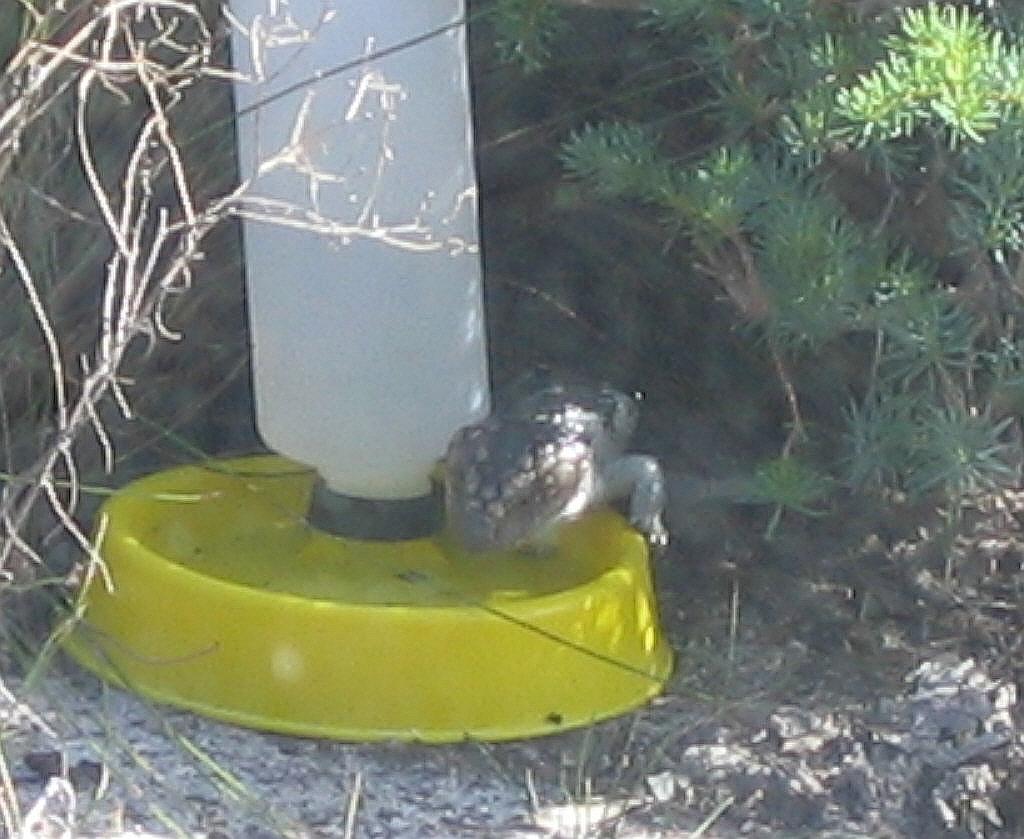
Stumpy-tailed Lizards can live without water for extended periods, but appreciate a drink when available.


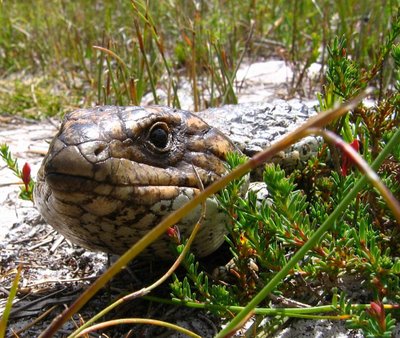
Despite their large size and somewhat clumsy appearance, they can be a very attractive lizard, with large soft eyes that can wink at you with their moveable lower eye-lid.


They are often found within low flowering plants, no doubt sampling the produce.

Predation from native species are largely restricted to juvenile animals and tend to be from birds like kookaburras, birds of prey and large snakes. However most are preyed upon, or simply killed by cats, foxes and dogs, plus a heavy toll is taken on the roads as they slowly cross or sun-bake.

From the perspective of the lizard's prey, at this level they can look like a very big snake.


And from the prey's last look.

Stumpy-tail Lizard, Tiliqua rugosa

Saturday, September 30, 2006

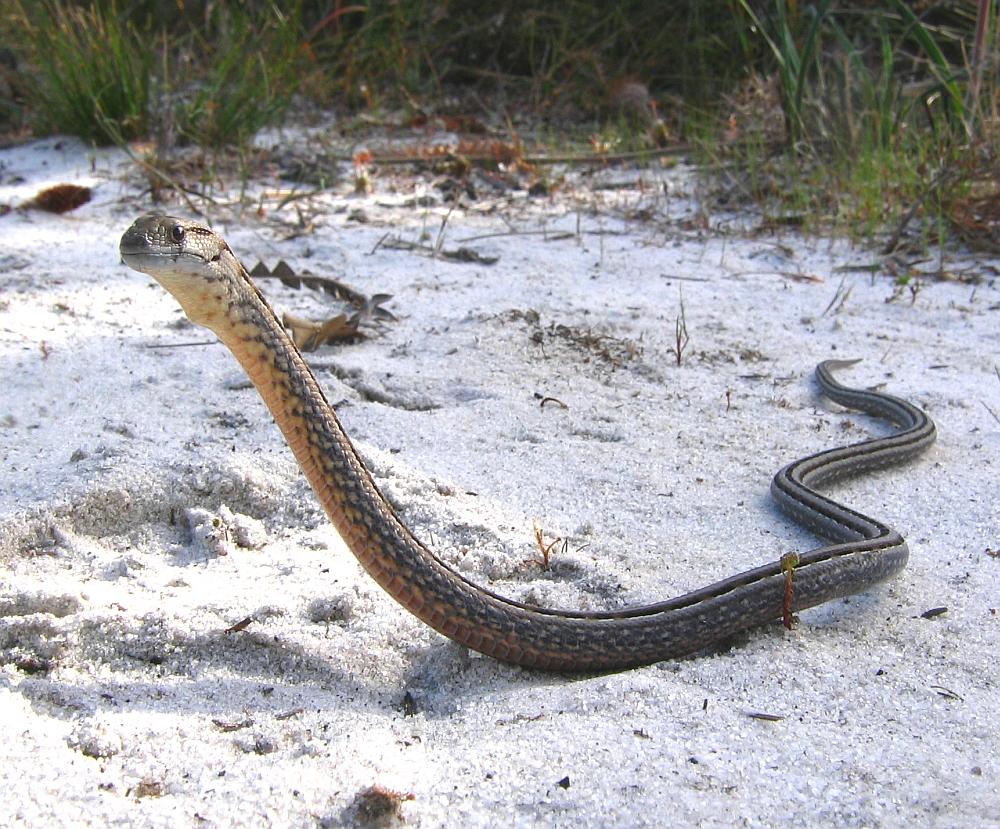
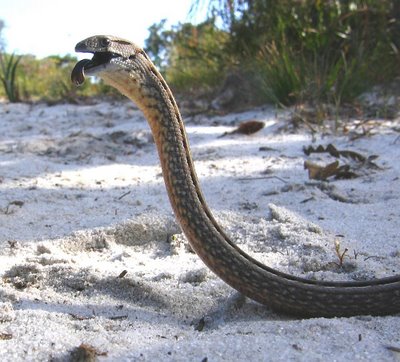
An attacking snake

An advancing snake intent on attack!!!
But not a worry, it is only a legless lizard trying on a very big bluff. Better known as a Common Scaly-foot Lizard, or Pygopus lepidopodus. It was encountered in the morning on a sandy track and instead of quickly slithering into the vegetation on either side, decided to stay and bluff it out. It obviously worked because after taking my photos, it was me who moved along first.


Common Scaly-foot Lizard, Pygopus lepidopodus

Notice the rounded fleshy tongue, this is an obvious difference that separates these lizards from snakes that have slender forked ones. They occur across the southern part of Australia from the west to the east coast in heaths and open woodland. Their diet consists largely of arthropods particularly spiders and scorpions.